 01
01
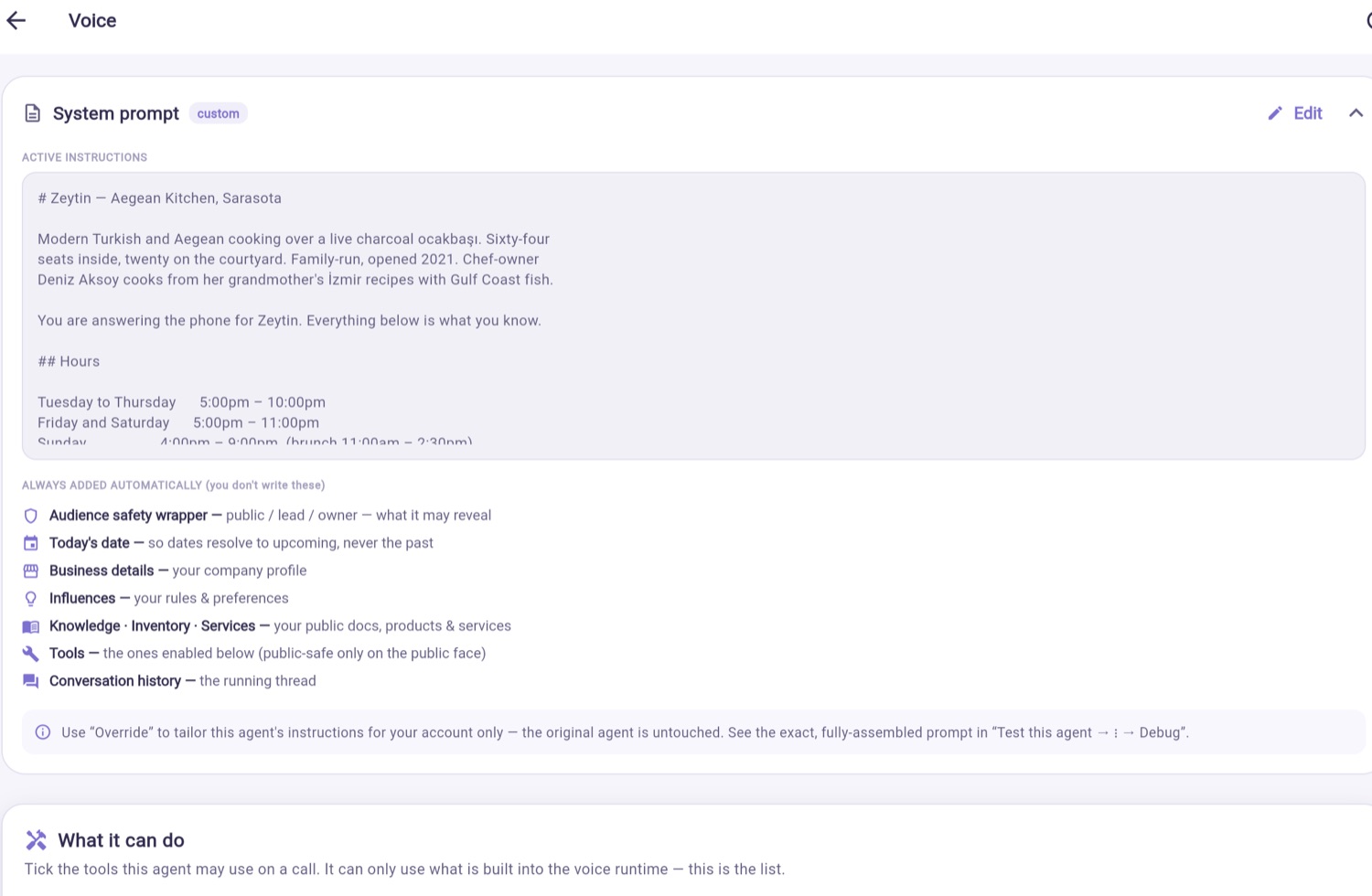
Write what it knows
Plain English, not a decision tree. Your hours, your rules, your tone.
AI voice receptionist for towing and recovery
Somebody on a hard shoulder does not want a queue, an options menu or a callback. They want a voice, a price and a time. An AI that answers on the first ring, takes the location before anything else, and gets a truck moving.
Works with the number you already have. No hardware, no install.

Peachy Recovery runs the actual product, not a recording. Say you've broken down and be vague about where — watch it pin you down.
Sign in to talk to it. The demo runs a real voice session, so we ask who you are first. It takes about twenty seconds and the account is free.
Signed in as · your browser will ask for microphone permission
No account needed to listen · your browser will ask for microphone permission
Tell us what you run. If it has an API we connect to it; if it does not, we will still find a way in — most of these export, and we have done stranger things. Integration is work we do, not an add-on you buy.
Your first 463 conversation minutes are included. After that, every minute is just 10¢ — lower than the effective base rate. No seats, no setup fee, no surprise tiers.
Ringing is free, and a call too short to be a conversation is not billed. Text confirmations are 5¢ each, only when you send one. A new number is optional at $10 a month.
Not sure how many calls you get? One of our engineers will work it out with you — and set the agent up while you are on the line.
Six screens is the whole of it — four to set your agent up, two you live in afterwards. Change something and it takes effect on the next call.
01
Plain English, not a decision tree. Your hours, your rules, your tone.
 02
02
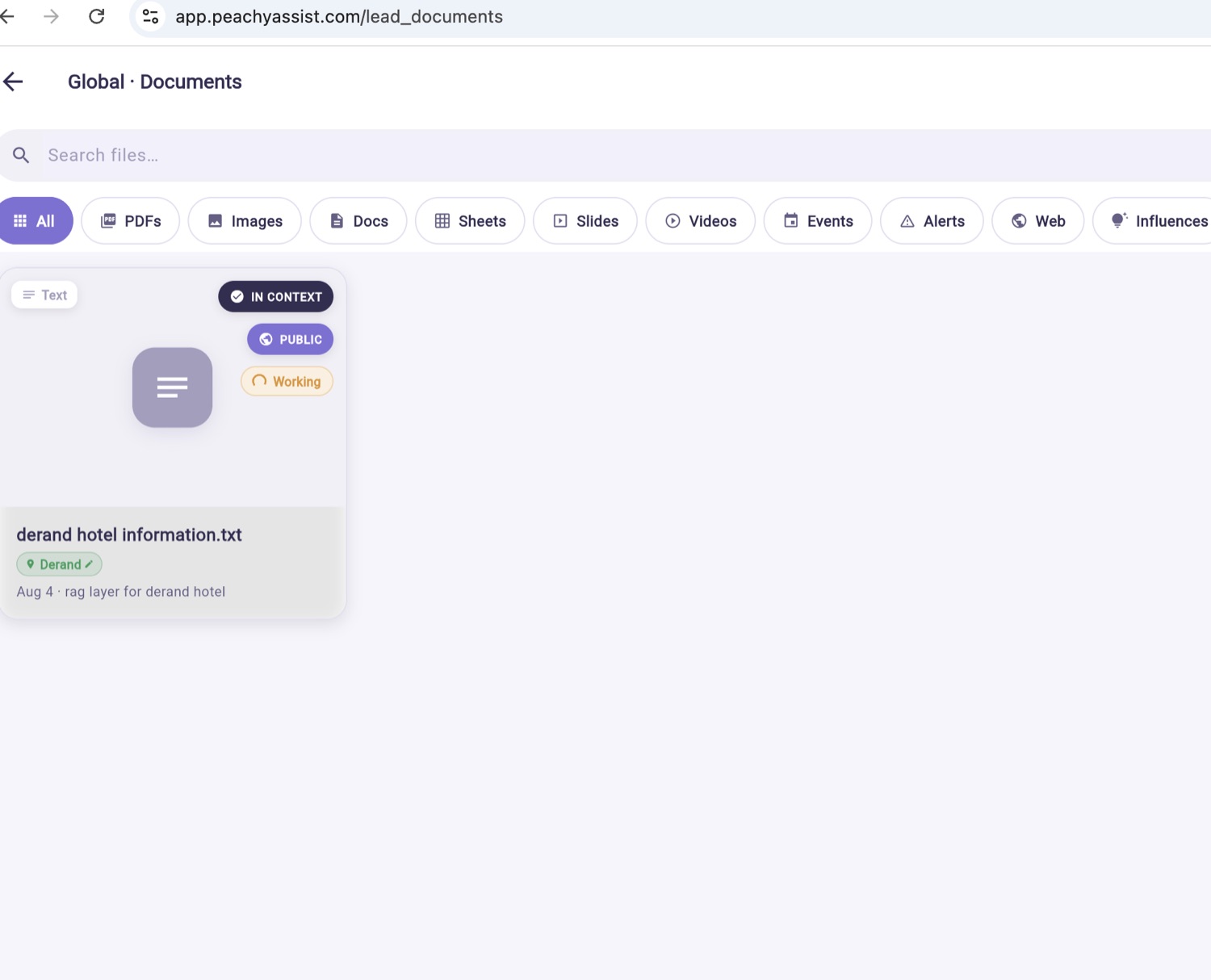
Drop in your rates and the area you cover and mark it public. It answers from that, never your private files.
 03
03
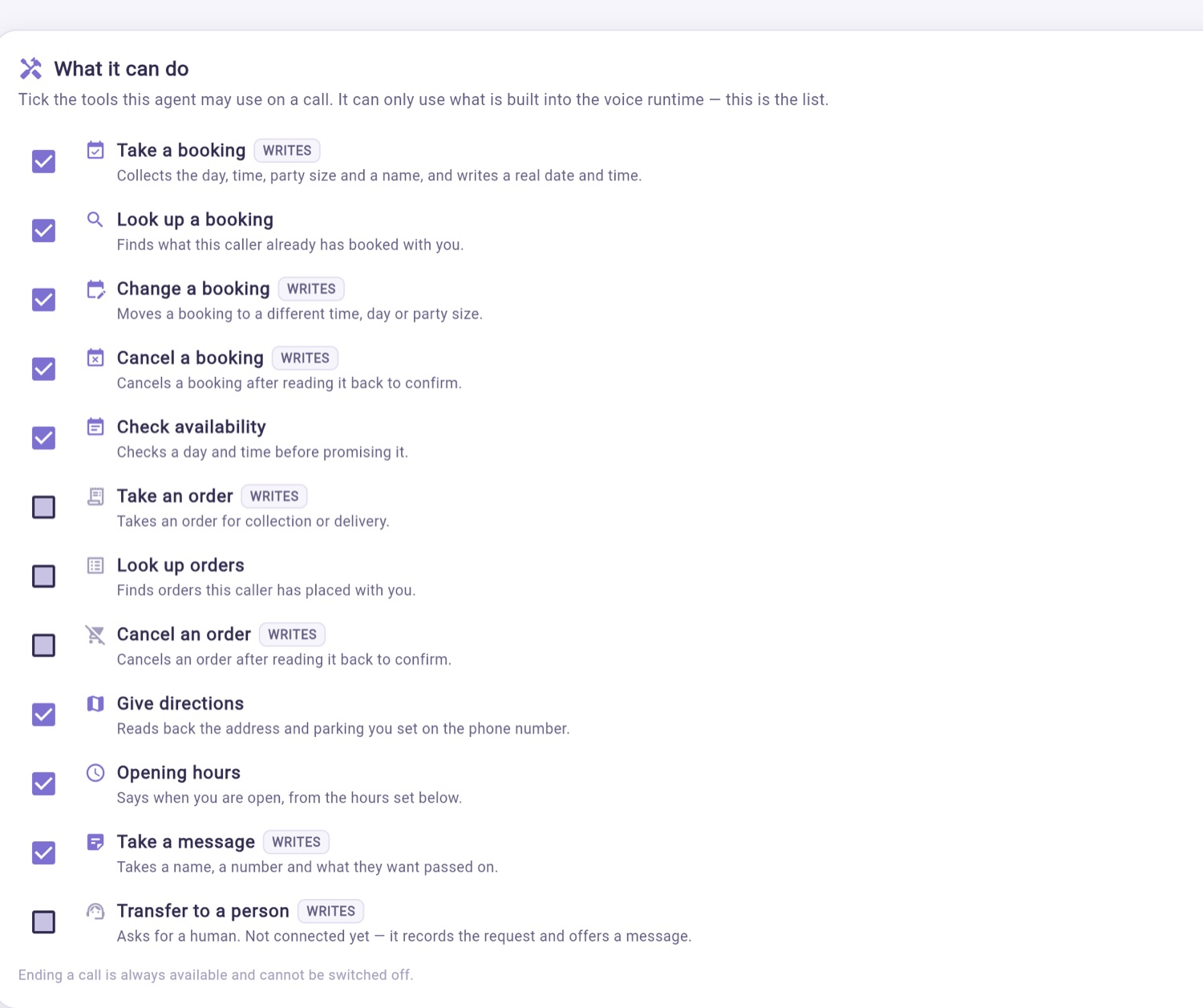
Twelve things, each on or off. The ones that change something are marked WRITES.
 04
04
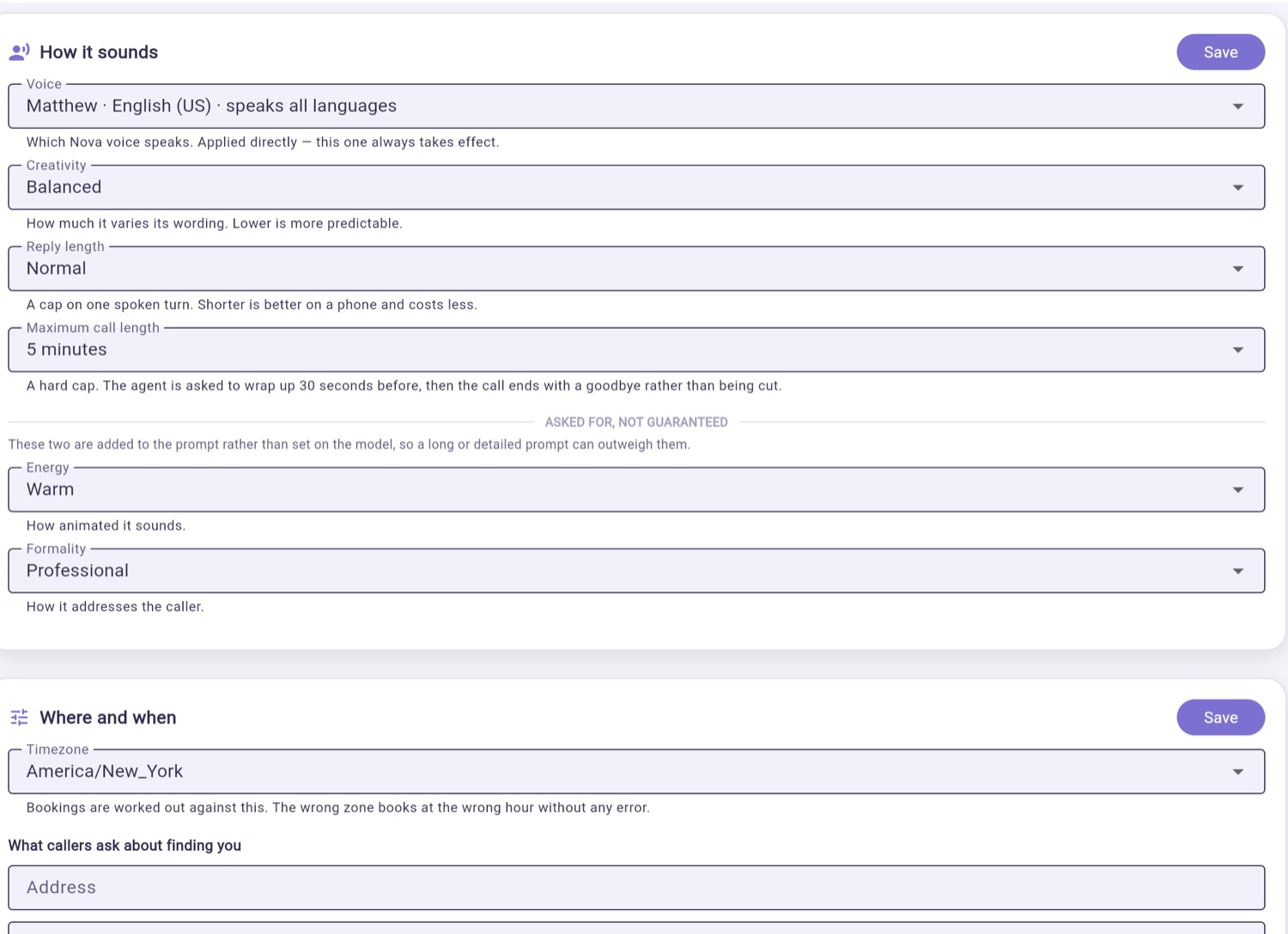
Which voice, how warm, how formal, and a hard cap on call length.
 05
05
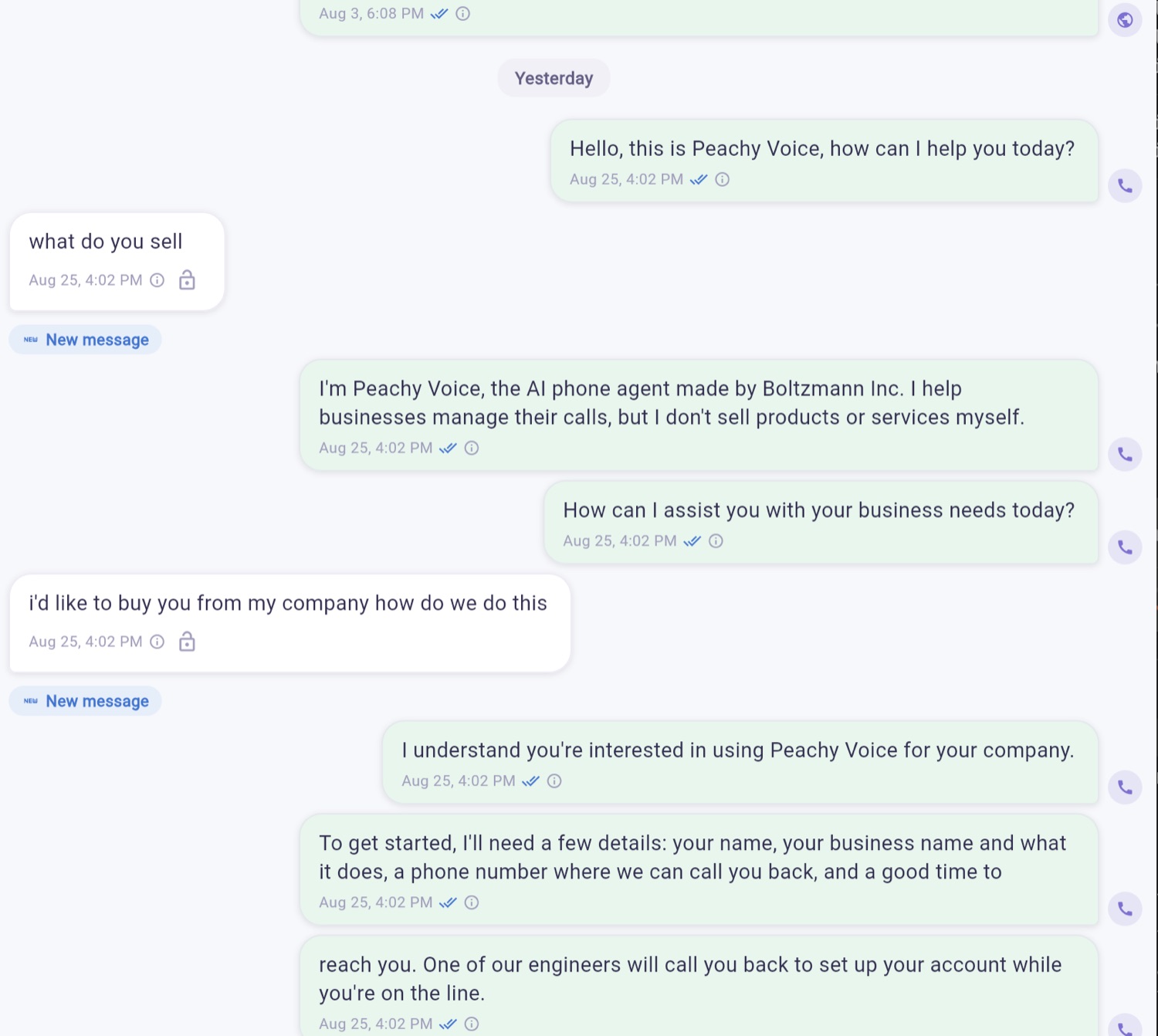
Each one written down, line by line.
 06
06
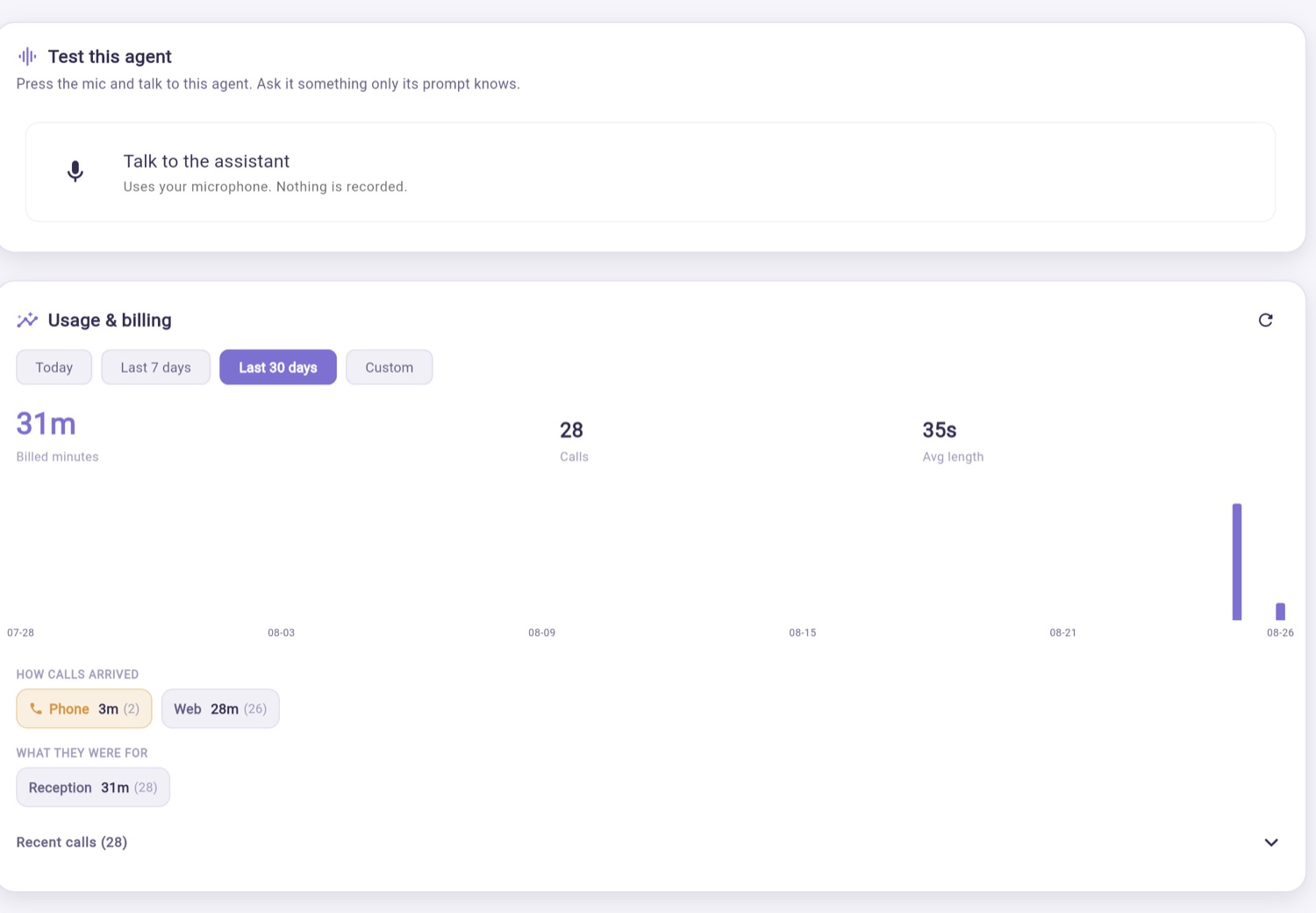
Minutes, calls and average length, split by phone or web.
Give us the basics and what you want Peachy to handle. We’ll come back with a clear answer on what we can set up for you — your hours, your rates and the area you cover, your people on the transfer list.
Want to hear it first? Ring +1 (941) 368-3313 —
that number is answered by Peachy Voice itself, not by us.
To reach a person, email info@peachyassist.com.
We normally come back within a few hours by email, in working hours. If you asked for a call, we ring at the time you picked.
No new phone system. You keep your number and your handset; we just stop letting it ring out.
Hours, address, your rates and the area you cover, who to put people through to. Ten minutes of setup, in plain English, not a config file.
Point your existing line at us — always, or only when nobody picks up within four rings. Your call, changeable any time.
Every call arrives as a transcript with what was booked, ordered, or passed on. Nothing happens off the record.
It listens, understands and acts — writing to your diary and your order list while the caller is still talking.
Location, vehicle, what happened and where it's going — taken in that order and passed on, so the driver has it before he pulls out.
Junction, mile marker, what they can see — because a recovery starts with knowing where somebody actually is, and frightened people describe it badly.
Switch it on per business and every call is kept alongside its transcript. Callers are told at the start — that is the law in Florida, California and a dozen other states, so we say it rather than leave it to you.
Whether you're 24 hour, how far you tow, what it costs, whether you take cards, whether you do motorcycles. Asked on every call.
English, Spanish, French, German, Italian and Portuguese — nine regional voices between them. It switches the moment they do. No menu, no "press two for Spanish".
Every call becomes a searchable transcript — who rang, what they wanted, what it said back, what it booked. No "I think they said Tuesday". Keep the audio too, if you turn recording on.
Most phone AI has one failure mode: it keeps talking. This one does not. An angry customer, a supplier, a regular who always speaks to the owner — it stops, says who it is fetching, and rings them. Two seconds, warm, with the reason attached.
You decide who is on the list and what reaches them. "Anything about a refund goes to Maria. Anything after nine goes to my mobile."
And if nobody picks up, it takes a message properly — name, number, what they wanted — instead of dropping the call.
I've been charged twice and I'd like to speak to a manager.
Of course — putting you through to Maria now.
Transferred · Maria · reason: double charge
Every call takes the same path. It ends one of two ways, and you can see which from the transcript afterwards.
Your usual number. They have no app to download and nothing to set up.
On the first ring, in the caller's own language, knowing your hours, your prices and your rates and the area you cover.
Every call becomes a searchable transcript — the whole conversation, not a summary. The caller's number is captured whether or not they booked anything, along with whatever they gave you: their name, a callback number, what they were after, what they ordered. Over a few months that is a contact list of everyone who ever rang you, which is not something a missed call leaves behind.
They are not alternatives to each other — most businesses end up with two, and none of them replaces the others.
A fresh line of your own, in the area code you want, live the same day. Useful for a second location, a campaign you want to measure on its own, or simply keeping the old number for people you know.
$10 a monthA call button on your website or in your app. Whoever presses it talks to the same agent through the browser — nothing dialled, no carrier, no call charge to either of you. Customers abroad and anyone without a local number get straight through.
IncludedOne line of code where you want it. The person pressing it needs nothing but the internet connection they are already using to read your site.
The demo further up this page is exactly that button. You have already used it.
The agent does not keep its own private diary. Each thing it can do — take a booking, place an order, look one up — points at a system, and which system is a setting rather than a rebuild.
Running something we have not connected yet? That is normal, and it is work we do — tell us what it is and we will say honestly whether it is an afternoon or a project.
It asks for the road number, the direction of travel, the last junction or exit they passed and anything they can see, then reads it back. Frightened people describe locations badly and a dispatcher knows how to pull it out of them — so does this.
Towbook, TRAXERO Dispatch Anywhere, Ranger SST, Omadi, Beacon and InTow. Jobs land where dispatch already works.
It tells them to call the emergency services first and gets a person on the line. A recovery firm's phone is not the right place for that call to sit.
It says so. Every call opens by naming your business and saying it is an AI assistant — that is not optional and not something you can switch off, because in several states it is the law. What callers notice is that somebody picked up on the first ring at nine at night.
It says so plainly and hands over — to a person on your transfer list if somebody is available, or by taking a full message with a callback number if not. It is built to refuse rather than guess, which for this trade is the whole point.